

A journey into the heart of Italy’s rice fields and living history
“There is low land,” people used to say in the past — a phrase that perfectly described the hard labor required to cultivate it.
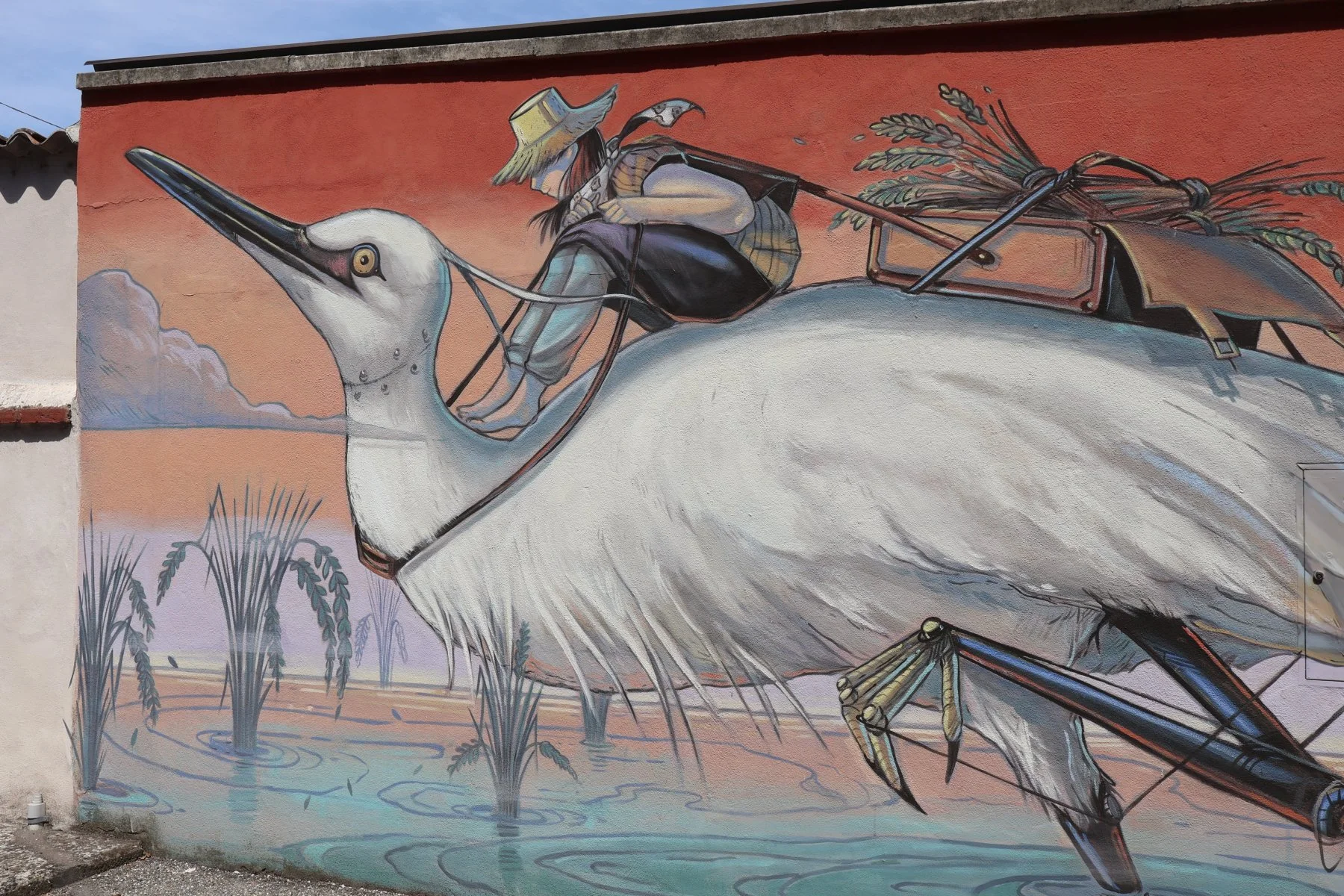
This was the world of the mondine, the women who worked in the rice fields of northern Italy. Bent over for hours, barefoot in water, they shaped not only the landscape but also an entire cultural identity.
When we arrived at Tenuta Colombara, in Livorno Ferraris (Vercelli, Piedmont), we had little idea of how much history could be hidden inside a single grain of rice.
Today, technology dominates rice farming — GPS-driven machines and soil-sensing systems — but the story of this land still lives in the memory of those who experienced it. And it must not be forgotten.
We are in one of the most fascinating areas of northern Italy: the Rice Fields of Vercelli, part of the so-called Borghi delle Vie d’Acqua (Villages of the Water Routes).
The Rice Fields of Vercelli: Where Water Shapes the Landscape
In this quiet but deeply alive land, seasons transform the landscape like nowhere else.
Water is the true protagonist here — separating and connecting land, turning rural “grange” into islands and, in spring, creating a patchwork sea of flooded rice fields reflecting the sky.
This is a territory rich in history and culture, linked to figures such as:
- Camillo Benso di Cavour
- Galileo Ferraris
- Giovanni Battista Viotti
- Roberto Bolle
Just a short drive from Turin and Milan, this is one of the most authentic and underrated off-the-beaten-path day trips in Northern Italy, perfect in every season.

The Cistercian Monks and the Origins of Rice Cultivation in Vercelli
Rice cultivation in this region dates back to the Middle Ages.
Around the 12th century, Cistercian monks from France, invited by Marquis Ranieri I of Monferrato, began reclaiming the marshy land.
In 1123, they founded the Abbey of Santa Maria di Lucedio, which became the center of agricultural innovation.
They drained wetlands, built irrigation canals, and transformed the plain into fertile farmland — laying the foundation for what would become Italy’s most important rice-growing region.
From this system were born the “grange”, agricultural estates where monks lived and worked.
Today, one of the most remarkable remnants of this history is the Bosco della Partecipanza di Trino, a unique ancient forest surrounded by rice fields — a rare example of medieval community-based sustainability still in use today.
Why the Bosco della Partecipanza Still Exists Today
The Partecipanza is a medieval institution dating back to 1275, when Marquis Guglielmo VII of Monferrato donated the forest (about 600 hectares) to the people of Trino.
The rules were revolutionary for the time:
- The forest could be used only collectively
- Wood could not be sold or transferred
- Rights were inherited within families
Originally reserved for men, today it is open to women as well.
Even before 1275, the forest was protected as part of the “Lucus Dei” — a sacred grove believed to be dedicated to Apollo.
Now it remains a biodiversity hotspot, visitable on foot or by bike, with facilities including parking, accommodation, picnic areas, and playgrounds.
Tenuta Colombara: A Living Museum of Rice Culture
Among the historic “grange” of the Cistercians, one place stands out: Tenuta Colombara.
This historic estate can be visited thanks to the unforgettable storytelling of Mario Donati, a true oral historian of the rice fields.
Mario is not just a guide — he is a storyteller.
His background in radio gives him a powerful narrative style that blends Italian and Piedmontese dialect, turning every visit into a deeply immersive cultural experience.
His stories are vivid, emotional, sometimes raw — always unforgettable.


Who Were the Mondine? The Women Who Shaped Italy’s Rice Fields
The mondine were seasonal female workers who “weeded” rice fields from planting to harvest, especially between the late 19th and mid-20th century.
They spent long hours standing in water, bending over to clean and maintain the fields.
Despite harsh conditions, they represented one of the first forms of female economic independence in rural Italy.
They lived together in dormitories, sang while working, and created strong social bonds.
Their protest songs became symbols of resistance — including early versions of what would later become the famous anthem “Bella Ciao”, originally born in the rice fields.
With mechanization in the 1950s and 1960s, this profession disappeared almost entirely.

“Bella Ciao” and Its Rice Field Origins
Before becoming an international resistance anthem, “Bella Ciao” existed in different versions sung by the mondine.
One early recorded version was performed by Giovanna Daffini in the 1960s, who brought the song to the 1964 Spoleto Festival.
The lyrics described the exhausting life in the rice fields — mosquitoes, long hours, and hard labor — long before it became a political symbol.
Alla mattina appena alzata
o bella ciao bella ciao bella ciao ciao ciao
alla mattina appena alzata
in risaia mi tocca andar.
E fra gli insetti e le zanzare
o bella ciao bella ciao bella ciao ciao ciao
e fra gli insetti e le zanzare
un dur lavor mi tocca far.
One of the earliest recordings of this version was made by the singer Giovanna Daffini in 1962. In 1964, Daffini herself presented the song at the Festival dei Due Mondi in Spoleto, where it was recognized as part of the mondine repertoire.
Tenuta Colombara and Acquerello Rice: Innovation Meets Tradition
Tenuta Colombara is much more than a historic estate. It is a place where time does not feel linear, where centuries of agricultural history coexist with cutting-edge innovation in rice production.
Originally, this was already an active structure as far back as the 1400s, long before it became associated with modern rice cultivation. In its earliest form, it served as a shelter for travelers crossing this part of Piedmont — a quiet but strategic stop in the rural landscape of what is now the province of Vercelli.
Over time, the estate evolved into a fully self-sufficient rural complex. What we see today is the result of centuries of transformation: homes for workers, stables, small workshops, a school for farmers’ children, and communal spaces where life unfolded around the rhythms of the rice fields.
In the 1920s, one of its most symbolic spaces was built: the dormitory of the mondine, the women who worked seasonally in the rice fields. Today, this building has been reborn as the “Conservatorio della Risicultura” (Rice Culture Conservatory) — a place dedicated to preserving the memory of rice farming culture in Italy.
But Tenuta Colombara is not only about the past.
It is also the birthplace of one of the most refined rice products in the world: Acquerello Rice, a premium Carnaroli rice that has become a reference point for top chefs internationally.
Here, tradition does not exist as nostalgia. It is a foundation on which innovation is built. The estate is still active, still producing, and still evolving — proving that agricultural heritage can be both preserved and reinvented without losing authenticity.
And this balance between memory and progress is exactly what makes Tenuta Colombara one of the most fascinating rice estates in Italy.
What Makes Acquerello Rice So Special? A Grain That Preserves Its Memory
To understand Acquerello Rice, you first need to understand what rice truly is — not as a simple side dish, but as a complex grain composed of multiple layers, each with a specific role.
When harvested, rice is naturally protected by an outer husk called the “lolla”, a tough fibrous shell that must be removed before consumption. Once this outer layer is taken away, what remains is brown rice, which still preserves its most valuable nutritional parts.
Inside the grain, in fact, there is a structure made of several layers:
- the outer bran layers
- the germ (or embryo), rich in nutrients
- and the inner starchy core
The germ is particularly important. It contains vitamins (especially B and E), minerals, and essential fatty acids. It is the “living” part of the grain, but also the most fragile one — and during traditional polishing processes, it is often lost or damaged.
This is what usually happens in standard white rice production: the grain is polished until only the starchy core remains. The result is a rice that is easier to store and visually more uniform, but nutritionally poorer compared to whole grain rice.
Acquerello Rice, produced at Tenuta Colombara, changes this logic completely.
Through a patented aging and processing method, the rice undergoes a unique transformation:
- first it is carefully refined to obtain white rice
- then, in a controlled process, the germ that was separated is reintegrated into the grain
This is what makes Acquerello truly different: it is not simply white rice, nor brown rice — it is a hybrid that combines the advantages of both worlds.
From a culinary perspective, this means:
- the cooking precision and consistency of refined rice
- the aromatic depth and nutritional richness of whole grain rice
- a texture that remains firm, creamy, and highly appreciated by chefs
It is no coincidence that Acquerello Carnaroli rice from Vercelli is considered one of the finest rices in global haute cuisine, used in restaurants where risotto is treated as a signature dish rather than a simple preparation.
In a region where rice has shaped landscapes, culture, and livelihoods for centuries, Acquerello is not just a product — it is the evolution of an entire agricultural tradition.

The Panissa Vercellese: A Dish That Tells the Story of the Rice Fields
Panissa Vercellese is not just a recipe — it is the culinary identity of the Vercelli land: a traditional Piedmont rice dish born from the life of the rice field workers.
This is a dish that belongs to the world of the mondine, the women who spent entire days working submerged in water, bent over in the rice fields of northern Italy. It was created as a meal capable of providing energy, warmth, and comfort during long hours of exhausting labor.
Simple, rich, and deeply rooted in the land, panissa was born in the countryside of Piedmont, where rice fields stretch as far as the eye can see — the famous “sea of squares” of Vercelli.
At its core, panissa brings together the essential ingredients of this territory:
- rice (the true king of the Po Valley)
- beans from Saluggia
- pork products such as salam d’la duja
- onion, lard, and red wine
A humble combination, yet incredibly powerful in flavor and cultural meaning.

Final Thoughts: Why Visit Tenuta Colombara?
Tenuta Colombara is far more than a rice farm.
It is:
- a living museum of rural Italy
- a place where history is still told in first person
- a journey through the origins of rice culture in Europe
- one of the most authentic hidden gems near Turin
Above all, it is a place where stories — like those of Mario — make you understand that every grain of rice has a memory.




Leave a Reply